
The point of trade agreements, above all, is to establish clear rules for cross-border commerce, so businesses can make sensible decisions about importing, exporting, and investing. One year into Donald Trump’s second presidency and that rationale is pretty much out the window when it comes to trade relations with the United States. The U.S. seems to have no compunction about ignoring agreements to which it is a party. This has major implications for value chains.
Diplomacy is a stop/start process, and no trade agreement is perfect. But agreements mean little if there is scant likelihood of compliance. Canada and Mexico were hit with 25% U.S. tariffs in 2025 in blatant disregard of the sweeping 2019 trade agreement between the three countries — never mind that negotiations to revise that agreement were already on the calendar for 2026. Colombia and the United States agreed to phase out tariffs on each other’s goods in 2012, but Colombia nonetheless got hit by a 10% tariff on most imports last April. The United Kingdom raced to get in the President’s good graces by striking a vague “Economic Prosperity Deal” in May 2025, but in mid-January Trump threatened it with additional tariffs if it did not support his demand that Denmark yield control of Greenland to the United States. Similarly, the European Union, Japan, South Korea, and other trading partners have found that their painstakingly bargained trade agreements with the United States are not binding.
While the U.S. Supreme Court may soon reject the claim that an “emergency” allows the president to impose tariffs as he desires, It is notable that neither major political party has had much to say about the Administration’s disrespect for U.S. trade agreements. This bipartisan indifference suggests that U.S. adherence to its commitments may remain uncertain even after Trump leaves office.
For more than a decade, many firms that once sourced mainly from China have quietly opened factories or sought suppliers in other countries. That approach, known as “China plus one,” may no longer be sufficient. With the United States now sanctioning numerous trading partners as it sees fit, managing value-chain risk may require multiple options in case a second-choice supplier country falls from Washington’s good graces. “China plus two or three” is likely to be an expensive strategy, making it harder to gain economies of scale, but it may be wiser than assuming that U.S. trade agreements will be adhered to.
Tag: Tariffs
-
China Plus Two or Three
-
The Government’s Tariff Bill
U.S. tariffs supposedly generated a record $31 billion in revenue during the month of August. According to a breathless report from Fox News, “The US could collect as much tariff revenue in just four months to five months as it did over the entire previous year.” But while those numbers may prove accurate, they represent only one side of the federal government’s ledger. There’s hasn’t been much attention to the fact that with the tariffs Washington is effectively taxing itself.
President Trump has set a tariff rate of 50% on steel, copper, and aluminum imports from most countries, excluding Great Britain. He has also imposed a 50% rate on the steel or aluminum content in 407 different products, from truck trailers to barbecue forks with wood handles. Those tariffs don’t just affect imports. By making foreign products more expensive, they make it easier for domestic producers to jack up prices; were that not the case, the tariffs would serve no purpose.
And who buys that domestic metal? Much of it ends up in goods purchased by Uncle Sam (fighter planes, postal delivery trucks) or by state and local governments using federal as well as state money (girders for highway bridges, pipes for water systems). With the tariffs in effect, governments buy less with each dollar they spend on such things.
Steep tariffs on pharmaceuticals are supposedly impending. The United States and the European Union have agreed that European drugs will face a 15% U.S. tariff, and Trump has threatened tariffs of up to 250% on drugs from other countries. Since the Washington pays 59% of the cost of outpatient prescription drugs and the states pay another 5% to 10%, governments will bear most of the burden of higher prices.
These tariffs are not affected by the recent court decision blocking many of the tariffs Trump has proposed. They could remain in place indefinitely. And as long as they do, U.S. taxpayers will pay far more than they should for the goods their tax dollars buy.
-
Dominance
Donald Trump is into dominance. In a series of orders since he started his second term last January, he has proclaimed his intention to restore America’s maritime dominance and its energy dominance, to make the United States dominant in cryptocurrency and artificial intelligence, and to maintain the dollar as the world’s dominant currency. And that’s not all. “America’s destiny is to dominate every industry,” he told an audience in Pennsylvania on July 15.
In recent days, Trump reasserted his belief in U.S. dominance by announcing steep tariffs on many countries. His quest for dominance goes beyond eliminating bilateral trade deficits. He has placed tariffs on imports from Canada, supposedly because it allows fentanyl to cross the border into the United States; and on Brazil (with which the United States has a trade surplus) to punish it for prosecuting a former president for plotting the violent overthrow of the government; and on India, supposedly because it purchases oil and military equipment from Russia. Tariffs, he clearly believes, are a useful cudgel to force other governments to conform to his desires.
In the short term, large bilateral trade deficits have made it difficult for trading partners to retaliate when Trump nullifies longstanding trade agreements and announces new import barriers. In the longer term, though, such policies threaten the United States’ central place in the world economy. U.S. disinterest in expanding international trade and negotiating multilateral agreements is not shared by most other countries, which are busily signing trade packs that do not include the United States. Talk about creating a substitute for the World Trade Organization without U.S. involvement is widespread.
Already, traders are responding to America’s anti-trade agenda by finding other partners. “Since this March, China-ASEAN export volumes are now double that of China-US, traditionally the most important route in container shipping,” Bloomberg reports. On August 5, the Bureau of Economic Analysis confirmed that while U.S. imports are declining, its exports are in decline as well. As America withdraws, other countries are moving forward, and U.S. dominance is slowly falling away.
-
Factory Job
The Trump Administration is racing to discharge tens of thousands of federal workers in order to do away with government activities it dislikes. And what are those displaced workers to do? Treasury Secretary Scott Bessent offered an answer on April 7. “[W]e are shedding excess labor in the federal government,” he said, adding, “That will give us the labor that we need for the new manufacturing” which, he asserts, the Trump Administration’s higher tariffs will bring to the United States.
This advice fits neatly with persistent claims that manufacturers can’t find workers. Last year, the head of the National Association of Manufacturers claimed that there were 800,000 unfilled manufacturing jobs. That number is likely to grow if the Administration succeeds in reducing the number of immigrants in the United States.
This purported labor shortage is usually attributed to spoiled workers who avoid jobs that can be dirty and physically taxing. As one economist insists, “Young people, especially, are not interested in jobs in manufacturing.”
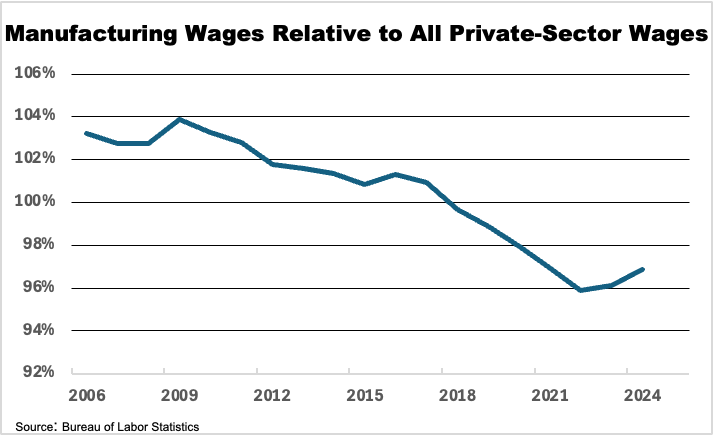
Count me as skeptical. In general, I think, workers are good at sniffing out the best opportunities. The reason many shun manufacturing jobs is that, on average, they are no longer good jobs. Manufacturing workers used to earn a premium relative to workers in other industries. Due in part to foreign competition, that premium has vanished. Many of the fringe benefits that union factory workers used to enjoy have vanished as well.
If theory, higher tariffs should help manufacturers earn greater profits from U.S. operations. But will higher profits mean better pay? It hasn’t worked out that way in the past: in primary metals, where steep tariffs protect the steel and aluminum industries, inflation-adjusted wages for production workers are five percent below their level in 2005. Does Mr. Bessent have a plan to ensure that any benefits of disrupting global supply chains are spread widely? If not, persuading displaced federal workers to staff newly built factories may be a hard sell.